Friday, 20 February 2015

Hoy (July 2014)

I wrote this back in August but totally forgot to post it...


Conor Gilmour is a bad man, or at least I’m particularly bad at not agreeing to go along with his ideas. So when last week he suggested we go climb the Old Man of Hoy, I couldn’t refuse, particularly since I already (somehow) had when he suggested it back in May.
The Old Man of Hoy is a particularly famous sea stack situated (unsurprisingly) on the island of Hoy. Unfortunately, Hoy is in the Orkneys, which are rather remote from Belfast. But an adventure is an adventure.
It is a 135m tall lump of Orcadian sandstone, situated on a platform jutting out of the western side of the island. Although sturdy looking, it has only existed for about 200 years – with no references to it before the turn of the 19th century. It’s changed even since then, with a substantial portion collapsing in the 1850s or so. It’s unlikely to stand for much longer, either.

I caught the ferry/bus to Glasgow on Monday 28 July and met Conor there that evening. Plans were hatched, shopping bought (including obligatory summit beer) and bikes loaded.
SKOOF, the Gilmourmobile

 The plan necessitated a 300 mile drive to Gill’s Bay in Caithness, whereupon we would catch a ferry to St Margaret’s Hope on Orkney Mainland (confusing name) and cycle the 30 miles round Scapa Flow to Stromness. From here another ferry would take us to Hoy, and a 5 mile cycle across the island would leave us at Rackwick, close(ish) to the Old Man. Simple.
Unfortunately, the 0700 start from Glasgow was not sufficient to reach the 1300 ferry in time (largely due to the frustrating lorries on the A9 road) and we arrived at Gill’s Bay at 1303, just in time to see the ferry pulling out of the harbour. This frustratingly left us with 6 hours until the next ferry, and we (wisely) decided that we would abandon plans to cycle round Orkney and would catch the direct ferry from the brilliantly named port of Scrabster direct to Stromness that evening. In the meantime, we went to the most northernly point in Britain (Dunnet Head) and saw puffins. Puffins are great.
There’s 21,000 people in the Orkneys. I was expecting something like the Aran Islands in Ireland but it’s nothing like that. There is apparently even a Sports Direct. You know your island is going places when it has a Sports Direct. The boat over, the Hamnavoe, was a lot bigger than I was expecting. We got a look at the Old Man on the way. He looked scary.
The aul' fella from the boat

When we eventually reached Stromness it was way too late to get to Hoy. Being intelligent we never bothered bringing a tent, and our plan of sleeping under a bridge was scuppered when it was found to be tidal. So we coughed up and stayed in a hostel, which was exceptionally pleasant.
Hoyward bound


Tuesday morning we got on to Hoy. The weather was pants. We spent an hour in the church at Moaness drinking free tea and coffee and reading about Hoy. When we eventually bit the bullet and cycled to Rackwick on one of Hoy’s two roads we got soaked. Things didn’t look promising.
Free coffee church

Rackwick is beautiful. It’s a little bay in the southwest of Hoy, with cliffs and hills on both sides and access along a glen through the middle of the island between some large hills which have claimed a number of aircraft over the years. The bothy we stayed in is right at the beach and is a lovely wee old cottage fully equipped with a toilet and a tap. We shared the place with a Lithuanian man who was cycling round Scotland but who was quite difficult to talk to.


Rackwick and the bothy

It didn’t clear up til Wednesday evening so we caught up on some sleep and listened to the crash of the waves. Thursday however dawned gloriously, so we got up at the crack of 0930 and set off towards the Old Man.
It’s an hour’s walk from Rackwick to the Old Man, along a great path. At the headland opposite the stack we paused to have a look at the bloody thing, which we now resigned ourselves to climbing since we’d come so far. It’s funny how psyche drains the closer you get to actually doing the thing you’re supposed to be psyched about. It rises from its platform like an improbably skyscraper, seemingly overhanging on every side, except for an open-book corner that starts at mid height. It was first climbed in 1966 and was made famous by a TV broadcast in 1968. Our route was the original east face (inland) route, graded E1 5b and supposedly one of the best routes in the country. We expected great things.

The scramble to the base of the Aul Fella is described as ‘trouser filling’ which is about right. This is probably the most dangerous part of the whole affair. Once safely down, Conor took the first lead. This was a lovely (if sandy) 4b pitch leading up the arête; Conor went first as he hadn’t done any trad climbing in months and this was supposed to be the easier pitch. This left me with the crux second pitch.
1st belay

looking up the crux

setting off on the crux

Conor following the crux

This pitch (rightly) has a bit of a reputation. It starts with an airy downclimb on the east face to a traverse, which in turn leads into a chimney. None of this can be protected as it will lead to sever rope drag later. The chimney starts off straightforward but before long leads into a sentrybox, the exiting of which involves thrutching outwards and up into a fist sized corner crack. It’s hard to describe the combination of chimneying/offwidthing/jamming/arête hugging involved in this. Once out of the sentrybox, straightforward climbing leads to a good belay, where you collapse and pant for a bit. Conor impressively managed it on second with a rucksack on.
We ended up splitting what is supposed to be pitch 3 into three smaller pitches due to rope drag and the profusion of amply-provisioned belay ledges. From here to the top, the climbing was easier but the ledges were colonised by Fulmars. Fulmars are evil gull things that vomit at you when you go near them. The whole stack smells a bit like a pet shop because of them.
FULMARS

Throwing shapes
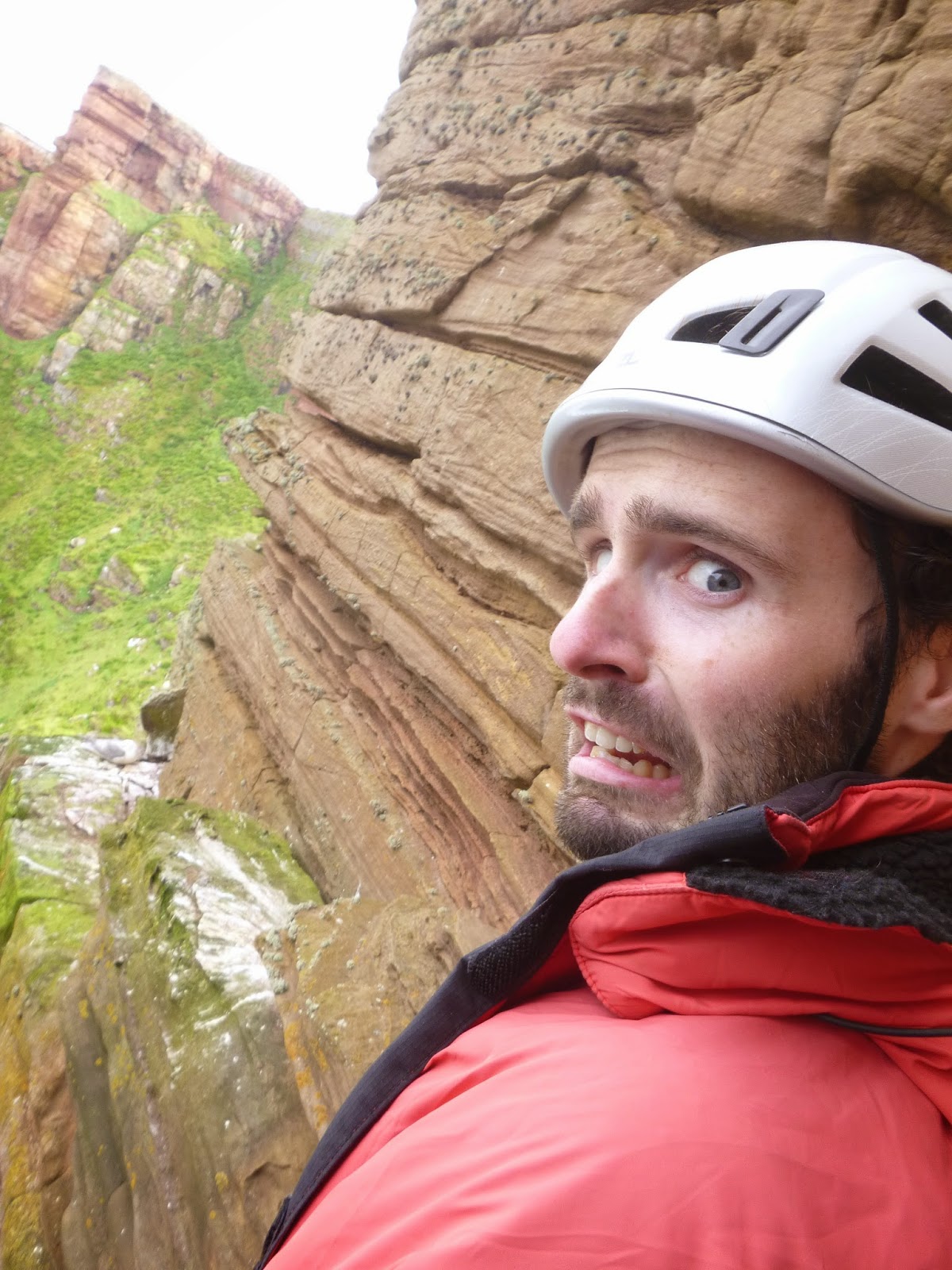
I don't like Fulmars (rightly, it turned out)

 The last of these subsidiary pitches I led. I (almost as an afterthought) clipped an ancient bit of stuck gear just above the belay and made the easy moves up to a ledge. From here, I reached up to the next ledge and pulled up, only for a baby Fulmar to appear right in front of my face and squawk. Instinctively I flinched and before I knew it I’d lost balance and was flying through the air; I saw Conor flying past at the belay before I came to a halt below him, smashing into a ledge ankle- and ass-first. I climbed back up to the belay and Conor asked if I was OK – adrenaline prevented me from knowing but after a minute or two I came to the conclusion that I had a slightly sore ankle and a badly bruised arse. But I was OK. I’d been fortunate – the old gear had held and my 7m or so fall didn’t come directly onto the belay. I’d managed a Factor 1.5 or so fall, which is quite a lot. In any case, I got back on and finished the pitch, shaking a bit, and trying to sneak past the bird that had caused my fall.
The final pitch

The last pitch was an amazing steep open-book corner, described as ‘an Orcadian version of Cenotaph Corner but not nearly so hard’. Indeed, holds keep appearing as you climb up it, and it’s never harder than HS, even if it does look E2 from below. A brief flurry of rain didn’t stop us topping out and donning the plastic Viking helmet which for some reason resides there. A celebratory beer was had and we abseiled off, with the ropes only getting stuck once (which Conor managed to free with some lateral thinking). The Fulmar that had caused my fall proceeded to vomit on my trousers as I abseiled. I really hate that bird.


Summit


Airy abseil


The last abseil (from the top of the second pitch) was free hanging and almost 60m. I don’t really enjoy abseiling but this was amazing, hanging in space between the Old Man and the sea and spinning in the breeze. Unfortunately landing in the ground meant I now had to walk, something my ankle didn’t enjoy, but my sprained ankle managed the hobble up the ‘trouser filling’ scramble OK and we celebrated survival of another daft adventure with another beer on the headland opposite the Old Man. Back to the Rackwick bothy and an early start the next day to cycle, ferry, ferry, cycle, drive home. 12 hours later we were back in Glasgow, and the next day a further train, bus, ferry, bus, drive and a lot of hobbling later I was back in Belfast.
19 hours of travelling (each way) is a long way to go for 4 hours of climbing but it was well worth the effort, even just to see the Orkneys, which are brilliant. Scapa flow is full of German warships which are apparently great for divers. The whole archipelago is more like Norway than Scotland.
 Just getting to the Old Man of Hoy is an adventure in itself, and the route itself is brilliant, like a mix of gritstone and Fair Head. Go do it, before it falls over, and mind the fecking Fulmars.

Push your limit, mind your ankle.


See this link for information on funny placenames in the Orkneys.


Tuesday, 17 February 2015

Scottish Weekend

I was supposed to head over to Scotland for a spot of Winter climbing with QUBMC a few weeks ago but couldn't go as I had to attend Mourne Mountain Rescue training.
It having been too long since I'd suffered Scottish-style and suffering from withdrawal, I booked onto the brilliantly cheap Citylink service to Glasgow and went over last weekend, meeting Conor.
Conditions and the forecast were excellent, and we had talked of heading to Skye for a Winter traverse of the Cuillins, but this is a huge objective best left for when conditions are absolutely perfect, and consultation with local expert Mike Lates revealed that while conditions were good, there wasn't really enough snow on the ridge and going would be slow. So we made alternative plans instead.

At 5am on Saturday we got up and headed north from Glasgow. I hate Alpine starts, but they do sometimes make for pretty amazing scenery.


Electing to head somewhere slightly more out of the way than the usual destinations, we headed up Glen Etive and parked at the base on Ben Starav, a ~1100m Munro, aiming for the rarely climbed but apparently classic 'Hidden Ridge' (IV).


This route has one of the hardest walks in that I've ever done (and I've done a few nasty ones). Starting at sea level, a deceptively easy walk into the base of the Coire led to a hard 90 minute slog up steep nevee to the base of the route. As good a reintroduction to Scottish Winter as any.


Despite all this, the weather was glorious and the wind was minimal. We soloed the first section of the route on good ice and snow, and glorious frozen turf - the best medium on which to climb, the reassuring thud of axes in good turf is without equal!

Before long we reached a pinnacled section of the ridge and roped up. These weren't that hard but we were out of practice. The route was soon finished - a lovely route, no doubt, but it felt easy for IV and was quite short, considering the walk in!


A long walk (Scottish descents always seem longer than the approach) and some bumsliding brought us back to the car, and we made our way to Fort William and the slightly unpleasant familiarity of the Ben Nevis North Face car park, forever associated in my mind with early starts, long hard days and the resentment of anyone with access to the upper car park. Still, we needed our Ben fix...

Camping on the snow in the car park was as much fun as getting up from a tent at 5am in Winter could be expected to be, the only silver lining being the warmth of the car as we ate breakfast. Psyche was, admittedly, low at this point, but it rarely isn't as far as Alpine starts are concerned. Despite seeking every excuse not to get on with the day's business, we always seem to accept our fate and get on with it, perhaps knowing we'd only resent ourselves later if we didn't! A strange business, this mountaineering.


There's a new path through the forest since last time I was on the Ben, which made life easier. The snow level was very low and the icy path to the CIC slowed things down a bit but we still reached the hut for 0815 and geared up. Conditions were once again excellent, not much wind and good visibility. We had vaguely hoped to climb the ultra-classic ice route Orion Face Direct but the upper face wasn't iced up enough so we had to settle for the ultra-classic Observatory Ridge (V, 4) instead!

This is considered the hardest of the Ben ridges and rightfully so! The route description was quite vague, mostly consisting of "gain the ridge from a rising left-to-right traverse, then turn the difficulties on the right". The actual route is slightly more interesting than that, but reasonably obvious - climb the bit that doesn't look as daft as the other bits!

Conor on one of the crux sections


The ridge is characterised by a steep buttress with eases off to a narrowing snow ridge with a number of smaller rocky sections along it. It then fades into the upper slopes of Zero gully towards the top. The first buttress presented the difficulties and was climbed in 5 quite hard (at least for us) mixed pitches. There was no rime on the rock but there were considerable amounts of iced up rocks - much better than the usual verglas; it was possible to climb (if not protect) this ice. The hardest sections of climbing were two traverses round a corner, dispatched excellently on lead by Conor. Apart from the first pitch, protection was adequate - which is more than can be said for most of the Ben. We mused that if we'd climbed this route before Hidden Ridge then we would never have bothered with a rope on the latter, the mixed climbing on Observatory Ridge being quite a bit harder.

After the initial buttress we arrived at a snow slope and started moving together on grade II ground. I belayed Conor on one more section of nervy (but solid) iced up rock, then we moved together on the remaining 400m or so of grade II/III snow and ice, finishing up the upper slopes of Zero Gully. The snow and ice were generally excellent - sometimes too good as our calves were on fire from so much frontpointing on névé!

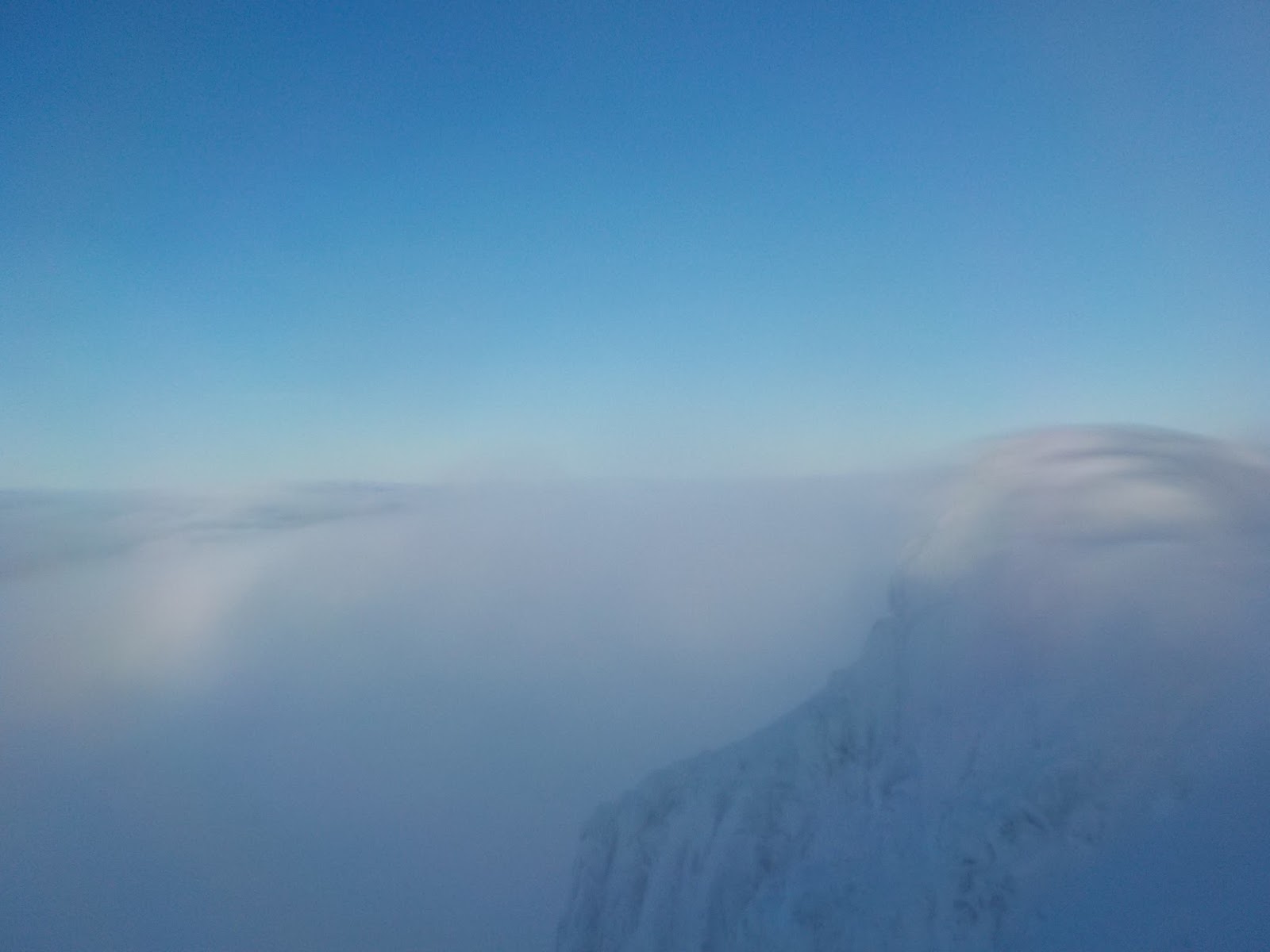
There was thankfully no cornice and we topped out at 1545 after 6.5 hours of climbing. The summit was above the clouds and empty apart from ourselves - indeed the whole mountain was strangely not busy, with no parties on some of the big classics you'd normally have to queue for like Point Five and Zero gullies (despite both being in excellent condition).


A long trudge back to the car and some fish and chips later we were back on our way to Glasgow, shattered. An excellent weekend in some incredible conditions - I've rarely seen it so good! A few days later I'm still recovering and catching up on sleep. Inevitably, I'm now psyched for Winter climbing - although it may well be a while before I get another chance at it!

Monday, 19 January 2015

The Mourne Wall

The last wee while I have for some reason gotten quite into running, with vague intentions of doing the Belfast Marathon and some silly long runs in the Mournes.
On St Stephen's Day I ran the BARF Turkey Trot, a short-ish 9 km run up Trassey Track to Pollaphuca, round Slieve Meelmore and down the Mourne Way back to Trassey track, in a bit of a blizzard. I wasn't particularly fast, and it didn't help that my somewhat inappropriate trail running trainers gave no grip on snow then proceeded to fall apart near the end, but it was great fun.

Several days later, armed with better shoes and a favourable forecast I went out for a lap of the Annalong Valley with Alek, starting from Carrick Little and taking in Cove, Beg and Donard. Alek injured his ankle on the Bog of Donard but we still managed the whole thing quite quickly. Movign fast in the hills is fun.
With Alek on Cove Mountain

The Mournes are a compact range, with an unusual feature circumnavigating some of the highest peaks - the Mourne Wall. This tremendous navigation aid was built in the early 1900s to demarcate the catchment area for Belfast's water supply. 35 km in length and composed entirely of dry stone wall, this superb folly crosses the summits of all of the Mournes' highest peaks, except Lamagan. Naturally, it makes for a perfect and challenging circuit.
The Mourne Wall route. Accepted practice is to avoid the horrible river crossing between Long Seefin and Carrick Little by going to the Head Rd, as well as crossing Silent Valley dam rather than following the edge of the waterworks.

I never really went outside much until I was 15, when i got dragged up Donard by a few friends from school. Considering ourselves instant experts on the Mournes, we decided to attempt the Mourne Wall on the subsequent occasion. Wearing jeans, a cotton t-shirt and carrying enough kit to keep a small family going for a week, we set out on the warmest day of July 2007 from Newcastle, getting as far as Hare's Gap before being put off by sweat and the steepness of Bearnagh. We camped at Ben Crom, got eaten alive by midges and walked back along the road to Silent Valley, giving up.
Over the next year or so we made several further 2-day attempts, each a bit less stupid and a bit more successful than the previous, but never actually completed the circuit in one go.


Several glorious attempts, all failed.

Last week, the idea came to me to try it again, but in one day, as fast as possible. Once I have an idea like that it kind of grows and grows and then I have to go do the thing, I don't really get a choice in the matter - even if it meant trying it on the coldest weekend of the Winter, which apparently last weekend was.
.
On Saturday 17 Jan, Owen Largey, Stephen Armstrong and myself set off from Carrick Little car park, up the track towards Binnian. The plan was a clockwise circuit, getting the worst of the ascent out of the way at the start, and avoiding the horrific crossing of the Annalong river at the end (which I'd struggled across in 2007 and had no intentions of ever doing again).

Setting off up the Carrick Little track, and Owen just before we bailed

It was cold but clear, with quite a lot of snow on the hills. However, on the ascent of Binnian Stephen developed back pain and although he was keen to push on, it was decided that the most sensible thing to do was to abort and return to the car.

There are, of course, two days in a weekend, and the forecast for Sunday was similar. Owen wasn't free on Sunday, and I didn't really want to try it again on my own, so I texted Adrian Curran, who's normally up for silly long runs and the like.

I picked him up on Sunday morning and he informed me that he had had 3 hours sleep after doing a VJ set in El Divino the night before while eating a pot noodle in the car. "It seems wrong not to be a bit hungover when going out in the hills anyway". Fair enough...

My little rear-drive couldn't make it up the icy hills on the Head Road so we parked at Dunnywater (which we'd have to come through anyway) and got the road running bit out of the way at the start. This would have been grim at the end anyway.
Ice skating on the Head Road


Off we went up Binnian, passing Saturday's highpoint quite rapidly. Before long we were breaking trail in sometimes deep snow (amusing in trainers) and strong winds but were making good pace. Descending the steep reservoir side of Binnian was slow going in the snow but 1hr 50 mins in we arrived at Silent Valley and were going strong.


Binnian

We knew the next section to the top of Muck would probably be the most difficult and weren't disappointed. The bog from the dam up to Slievenaglogh was as sodden as always. I was glad of my decision to pack spare socks but held off on their use until such a point as I started to lose feeling in my toes (thankfully this never happened).
Adrian was going strong while I struggled up Slievenaglogh, realising that I hadn't really brought enough food. One energy gel later I was a new man and only 3 hours in we were starting up Slieve Muck, the most appropriately named peak in the Mournes and the halfway point. Muck is steep and mucky, and the Banns Road side doesn't see much traffic (for good reason). The snow became quite deep and we were breaking trail, sometimes as much as knee deep. All quite demoralising.
Adrian on Slievenaglogh

At this point, Adrian had been moving longer than he had slept and started to flag. Some proplus and a sandwich kept him going. Caffeine is the business.


Muck

Once over the top of Muck things sped up. We were now back on well travelled ground, and the snow was nicely ploughed by plenty of footsteps. Deep snow slowed the uphill but made downhill fast and easy (and spared my knees).


Meelbeg and Meelmore

Adrian started getting bad cramp but an energy gel sorted that out (magic stuff those gels). Quick progress meant that only 2 hours passed from the top of Muck to Pollaphuca (col between Meelbeg and Meelmore). A short slog up Bearnagh saw us at the summit by 5.5hrs in. Here we met what seemed to be halfof QUBMC out walking and were gratefully refuelled by Owen and Aimee. I've never come down Bearnagh so fast. The Hare's Gap side is quite steep but the snow made for very rapid progress. It was no more than 5 minutes from the summit to the top of the steps at Hare's Gap. Only 4 more peaks to go.


Bearnagh
The last couple of peaks from Bearnagh. Slievenaglogh, Slieve Corragh, Slieve Commedagh, Slieve Donard


With about 25km and 2200m of ascent done so far, Adrian was suffering quite badly on the uphills at this point and had resorted to adding a cold & flu rehydration sachet to his water bladder in an attempt to get more energy. We made slow progress across Slievenaglogh (different mountain, same name) and Slieve Corragh and up the steep ascent of Commedagh, leaving only Donard and its bog. However, Adrian looked absolutely shattered and although stubborn it wouldn't've been wise for him to carry on over Donard. Thankfully, it was possible for him to follow the Brandy Pad track from the Commedagh-Donard col to the stile on the Bog of Donard while I carried on over the last summit.
I learned it is not a wise idea to eat a sandwich while trying to ascend Donard at a brisk pace, as chewing was enough to get me quite out of breath! I had the summit to myself and enjoyed the view of the sunset over the Wintry Mournes before legging it down the far side, meeting a much-rejuvenated Adrian at the stile.
View SW from Donard
Donard shelter


Normally, the Bog of Donard is a nasty, soggy, ankle ambushing morass which slows progress significantly, but on this occasion it was slightly frozen, allowing quick progress. As the light dimmed we covered the 5km back to Dunnywater in good time, arriving, shattered, back at the car in a total time of 8 hours, 39 minutes.
Obligatory victory photo


All in all, a great day out. It's hard to saw whether the snow slowed us down or not - it made us slower on the uphill, certainly, but downhills (except Binnian) were significantly quicker and the cold froze the Bog of Donard. Adrian could certainly have done with more sleep beforehand!
Attempting the Wall after a warm spell with dry bogs would be quicker but in the usual sogginess of the Mournes it might not be. Might just have to find out!
I never needed my spare socks, the Inov-8 Mudclaws keeping my feet warm enough (if not dry) and I brough enough clothes and water. Thick gloves were a godsend. If I were to do it again, I'd bring more gels and food, though.


GPS data here (distance is shorter than reality, somehow)